Continuous Ride Vent Net Free Ventilated Area
 Roof Intake and Outlet Vent Area Ratios for Proper Attic Venting
- POST a QUESTION or COMMENT about attic moisture, condensation & ventilation: what is the proper ratio of soffit intake to ridge outlet venting for roofs?
InspectAPedia tolerates no conflicts of interest. We have no relationship with advertisers, products, or services discussed at this website.
This article discusses How to Specify the Proper Roof Intake and Outlet Vent Area Ratios to Stop Building Heat Loss and Provide Proper Attic Venting to Avoid Condensation, Ice Dam Leaks, Mold, & Roof Structure Damage.
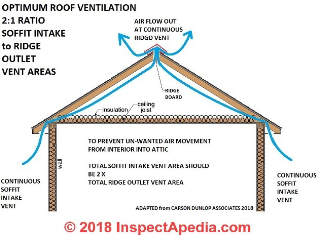
Our page top illustration, adapted and edited from Carson Dunlop Associates (found at page bottom, Click to Show or Hide), a Toronto home inspection firm, explains that to avoid un-wanted air movement from the occupied space into the attic or under-roof space, it is important to have the proper ration of soffit or eaves intake venting to ridge or roof top outlet venting: typically 2:1 soffit:ridge net free vent area.
We also provide an ARTICLE INDEX for this topic, or you can try the page top or bottom SEARCH BOX as a quick way to find information you need.
Vent Area Ratios: Attic Ventilation Soffit Intake to Ridge Outlet Air Flow or Square Inches Ratio
 Adding under-roof ventilation is usually a great idea, but if the relative sizes of the intake and outlet vents are not proper, the building will suffer increased heat loss and thus an unnecessarily high home heating bill.
[Click to enlarge any image]
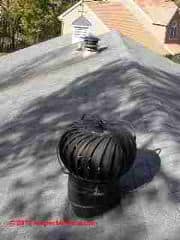
Our photo (left) illustrates use of a turbine vent on a house roof as a means of improving attic exhaust venting. Wind powered turbine vents are useful in special applications but in our OPINION do not provide uniform under-roof ventilation across the entire roof surface.
We often find that spot vents or intermittently-placed roof exhaust vents (or inlet vents) result in incomplete attic or under-roof venting, leaving moist, sometimes mold-contaminated areas of attic sheathing and framing in the un-vented spaces between the vent locations.
Details comparing various methods of roof ventilation are in the table below.
These recommendations are based on roofing industry standards, roof covering manufacturer recommendations, and on review of the literature on building insulation and ventilation, as well as on 30 years of building inspections, on the observation of the locations of moisture, mold, ice dams, condensation stains, and other clues in buildings, and on the correlation of these clues with the roof venting conditions at those properties.
We have also measured changes in airflow, temperature, and moisture before and after installing roof venting.
Continuous un-blocked soffit or eaves intake venting combined with continuous roof ridge venting (or equivalent area if the building framing does not permit a ridge vent) are needed to avoid ice dams, attic condensation, attic mold, rot, or insect damage from accumulating attic moisture.
But the ratio of intake air to outlet air is of critical importance too.
The ratio of soffit intake to roof outlet should be at least 2:1 to avoid unnecessary these heat losses from the building.
A serious error is a roof outlet vent net free area that exceeds the air inlets at lower roof edges or eaves.
See details at ROOF VENT NET FREE AREA
When this occurs in a climate where building heating is needed during part of the year, warm air leaking into the attic or roof space and exiting at the ridge vent (or other vents high on the roof) creates a convection air current that draws excessive heat out of the building during the heating season, leading to unnecessarily high heating costs.
But don't "fix" a bad intake to outlet air vent space ratio by reducing the ridge vent opening. Making this mistake can result in too little air flow under the roof surface, leading to indoor condensation and mold.
Roof intake venting with no outlet vent openings won't work because there will be no air flow through the roof cavity. In a few cases, very wide, open soffit vents at building eaves seem to result in a dry attic, but the design relies on a prevailing wind pattern that sends air through the attic. Even in this case most air flow will be across the attic floor, and an inspection of the attic near the ridge may reveal evidence of unwanted condensation and moisture staining or even attic mold.
Roof outlet venting with no intake venting won't work because the absence of sufficient intake of outside air to satisfy the negative pressure from air leaving at the ridge will cause draw warm air up from the building interior, increasing heating costs and possibly mold or allergen movement through the building.
Providing more soffit or eaves intake venting than ridge outlet venting assures that the airflow required by attic air exiting at the ridge is satisfied by incoming outside air rather than by pulling air up from the building where it not only brings up building moisture, it also increases building heating or cooling costs.
Building Code Requirements for Roof Ventilation
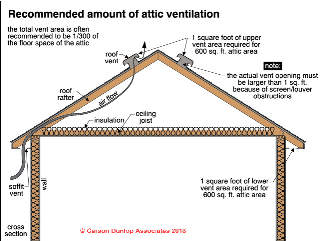
Carson Dunlop Associates' sketch above as well as several building standards and codes cited below provide recommendations for the total amount of under-roof or attic space ventilation.
Really? we do not recommend the individual roof vents such as illustrated in the sketch above as some areas under the roof will be left poorly-vented. See the page top illustration in which we prefer continuous exit ventilation at the ridge along with continuous soffit intake ventilation openings.
As detailed in Best Practices Guide to Residential Construction (found at page bottom, Click to Show or Hide), chapter on BEST ROOFING PRACTICES:
The rules of ventilation developed by researchers in the 1940s were adopted first by the Federal Housing Administration (FHA) and later by all the major residential building codes, including the 2003 IRC, with few changes. Most asphalt shingle manufacturers will void their warranties if these rules are not followed. They require:
- 1 square foot of net free vent area (NFVA) per 150 feet of attic floor.
- 1 square foot of NFVA per 300 square feet of attic floor if a vapor barrier is installed on the ceiling below.
- The IRC adds that the NFVA ratio can also be reduced to 1:300 if 50% to 80% of the required ventilation is located in the upper portion of the attic (or cathedral ceiling) and the rest is located at the eaves, with the upper vents at least 3 feet above the lower.
-- Adapted with permission from Best Practices Guide to Residential Construction (found at page bottom, Click to Show or Hide).
Types of Ridge Vents and Net Free Venting Area per Linear Foot | |
Roof Ridge Outlet Ventilation Product Examples | Sq.In. of net free ventilation |
| GAF Cobra® Ridge Runner™ exhaust vent | 12.5 sq.in. per linear foot, covered by cap shingles |
| GAF Cobra® exhaust vent: mesh type, roof nailing-gun-nailed | 14.1 sq.in. per linear foot, covered by cap shingles |
| GAF Cobra® exhaust vent: mesh type, hand nailed | 16.9 sq.in. per linear foot, covered by cap shingles |
| GAF Cobra® rigid Ridge Vent-2, Ridge Vent 3, & Snow Country ridge vent products | 18 sq.in. per linear foot, covered by cap shingles |
| Adjustable aluminum ridge vent (typical) | 18 sq.in. per linear foot, covered by cap shingles |
| Conventional rigid aluminum ridge vent (typical) | 20 sq.in. per linear foot, covered by cap shingles (est). |
| Roof louvers or "spot vents" (typical) | 50 sq.in. per vent, does not provide uniform ventilation between all rafter bays. Vent area ranges from about 35 sq.in. to 70 sq.in. for non-powered vents. |
| Turbine vents (wind-powered rotary, typical 12" to 14" diameter) | 120-240 sq.in. estimated equivalent vent area, does not provide uniform ventilation between all rafter bays. Varies by wind speed and turbine diameter/design. Installing without adequate air intake can result in significant building heat loss. Can be installed on sloped or flat roofs; consider for flat and low slope roofs. |
| Smart Vent™ by DCI for eaves with no overhang | |
| AccuVent™ attic ventilation roof baffle | |
Comments & Opinion About Statements of Net Free Ventilation Area of Various Roof Venting Products
Besides the rated air ventilation area described by various vent product manufacturers, other roof and vent opening details can significantly affect the actual airflow and level of under roof ventilation at a building.
While roofing product companies give useful general guidance on the amount of roof ventilation are recommended as a function of the square feet of attic space, here are some factors that could significantly change the actual recommended under-roof ventilation for a specific building:
- How wide was the cut made on either side of the ridge board to permit airflow into the ridge vent?
- Is the roof over an open attic, a partial attic with knee walls, or a cathedral ceiling?
- Is the building subject to usually high indoor moisture levels for any reason?
- What intake ventilation has been provided under the roof at the building eaves?
- How long and how open is the air flow pathway from building eaves (soffit) to ridge?
- How uniformly will the roof be ventilated by a given product? Will some roof areas or rafter bays be left un-vented?
Looking at a linear foot of a typical thick mesh-type ridge vent and before considering that power-nailing compresses the mesh to further reduce airflow:
If we cut a 1.5" gap between ridge board and remaining roof deck, 12" long, on each side of the ridge board, that's
12" x 1.5" x 2 = 36 sq.in. of open vent area (before any covering with the ridge vent material).
Suppose a roof vent product company indicates that their product is giving you 17 sq.in. of roof venting in a 12" length - roughly that's a 50% airflow restriction over the free opening, before allowing for other obstructions (rafters, air flowing downhill) - by this analysis.
But another step is needed:
This is how we think about vent area with a roll-out mesh ridge vent material:
The exposed *edge* of the mesh vent is all that can possibly vent out - that's typically about 1/2" to 3/4" high between the roof surface and the underside of the cap shingles on the roofs we have walked recently.
For a linear foot, after the cap shingles are installed, and counting both sides of the ridge, that's about 12 sq. in. of available space (1/2" x 12" x 2 sides),
We then cut that area in half to factor in the 50% mesh-restricted air flow rate that we found above, so we're really seeing an effective vent outlet, in the best case, of 6 sq.in. per foot.
Which is too little compared with the intake.
The appeal of the low profile roll-out type mesh ridge vent materials that are covered with cap shingles is aesthetic - the ridge vent looks nicer from the ground, and it's convenient on the truck - doesn't get dented, rolls up and stores nicely for transport, and installs over a non-straight ridge line, something that's a problem with the old vent type.
So we understand why it's a popular product. It just does not pass as much air as the older vent type.
We asked one manufacturer's mesh-type roll-out ridge vent vent tech-ref-salesman about their actual airflow tests and airflow venting rates at a JLC conference in the 1980's: he was flabbergasted - replying that he had no idea about any actual tests or measured numbers.
Happily most roofing product manufacturers such as the GAF are kind enough to provide their estimates of the amount of ventilation provided by each product.
A low profile mesh type and some other plastic ridge vents do not pass much air compared to an older (uglier) higher-profile rigid aluminum ridge vent. Where we are having difficulty obtaining good airflow under a roof (such as where there is limited air space between insulation and the roof deck, aggressive intake venting and properly sized outlet venting at the ridge can help assure that the limited vent space under the roof would have adequate airflow.
That's why we often suggest that uglier alternative exit vent, as well as suggest making sure that the roof decking slots for outlet venting at the ridge are cut correctly on both sides of the ridge board.
In general, you want 2x as much intake venting (at the eaves) as outlet (at the ridge) but keep in mind that if you use a mesh type "ridge vent" the ridge opening is obstructed by the mesh and the air flow will may be insufficient, so you can't just measure the sq.in. of vent opening, you have to also adjust the calculation for the degree to which the vent opening is obstructed by mesh, screening, and any other airflow obstructions such as under-sized cuts into the roof deck.
On older homes where rafters are wider apart than standard modern framing specifications (16" o.c.), a baffle that extends the full width between the rafters is the best you're going to get unless the owners opt for the more labor intensive and thus more costly approach of a site-built vent path that uses furring strips alongside rafters and solid foam insulation sheets to give a deeper vent path under the roof than provided by a baffle.
You'll want to look at the baffle selected to be sure it won't be compressed when insulation is added into the remaining roof space between the rafters.
About ice dams and roof ventilation
Increased air flow under the roof will prevent, not cause, ice dams, provided that insulation is also completely installed.
Ice dams occur because lost heat at the eaves melts snow there where the snow melt runs further down the roof to the cold overhang where it freezes. If we can vent enough air under the roof surface to keep the roof uniformly cold you won't ever see ice dams.
Take a look at ROOF ICE DAM CURE: Comparing Two Houses where we compare two under roof venting schemes on houses that happened to be side by side. We installed continuous soffit intake and ridge vent on the house at left; the house at right had almost no soffit intake venting.
See ROOF ICE DAM LEAKS for details about this topic.
You'll want to be sure air FLOWS continuously from soffit to ridge- if the baffles compress or the air space is too little (say less than 1/2"), or if the ridge outlet is obstructed by low-flow plastic mesh, then the risk of ice dams is increased - not because of the soffit inlet but because of inadequate outlet.
Put it another way, if you had no roof venting at all, heat lost into the roof cavity will cause ice dams.
In sum the building design least likely to give ice dams includes
- good soffit intake venting - not blocked by insulation, building framing, nor by my grandfathers's boxes of stuff stored there since 1942
- good ridge outlet venting - watch out for faux ridge vents nailed along the ridge without cutting the necessary opening through the roof sheathing
- good air path soffit to ridge - unblocked as air flows under the roof sheathing
- good insulation installation, no voids, extending all the way to the to plate over the walls but not blocking the soffit intake openings; or use baffles to keep insulation off of the roof sheathing to assure air movement at the tops of walls
- proper balance between intake and outlet vent openings: soffit vent opening = 2 x ridge vent opening
- assurance that airflow moves under all roof slopes and all areas of the roof, not just on one side of the building and not just between occasional bays formed by rafters on either side of a few spot vents installed in the roof surface
Last: don't forget the importance of also avoiding excessive interior moisture levels (a key factor in attic condensation and thus mold) - that wet basement or dirt crawl space needs to be addressed.
This is a section the article series, ROOF VENTILATION SPECIFICATIONS and is also part of our discussion
of ATTIC CONDENSATION CAUSE & CURE.
This article series describes inspection methods and clues to detect roof venting deficiencies, insulation defects, and attic condensation problems in buildings. It also describes proper roof ventilation placement, amounts, and other details.
Reader Comments & Q&A
 Thank you for the photo and challenging roof venting question.
I cannot give a single "right" answer to your question with any confidence, but I can pose some clarifying questions and give you some comparison data.
What is the object of the ventilation system you propose? Is it to cool the whole building interior space or to cool only the lower floor area? Do you want to exhaust the hottest air from the highest ceiling area below the glass roof?
I'm doubtful that a solar operated fan, whether 1 central one or two end ones or three together can successfully pull DOWN the hot air from the upper ceiling area under that glass that's certainly going to be getting a lot of solar gain.
The volume of your area is very roughly 200,000 cubic feet if I'm guessing correctly.
You don't show any fresh air intake design, making the job of exhausting the building perhaps more of a challenge yet.
Let's look at a popular solar-powered roof mounted exhaust fan,
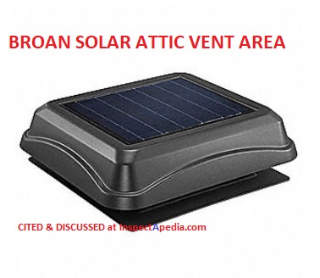
The Broan 345SOBK Surface Mount Solar Powered Attic Ventilator, 28-Watt, Black - shown below - can move about 537 cfm.
Even three of such fans only moves about 1,500 cfm and that's without considering the effect of limited fresh air intake, negative pressures in the building, difficulty pulling hot air down, and as you suggested, too, competition (probably not a big factor with small limited CFM fans far apart) .
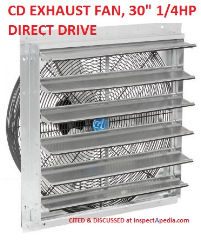
 In contrast, a typical direct-drive 30-inch 1/4hp louvered exhaust fan like the one shown above, (made by CD and available at Grainger and other suppliers) vents up to 8,000 cfm on high speed.
If this were my project I'd want a qualified HVAC engineer or an architect, a real one who knows building ventilation, to do some calculation and to come up with both a definition of requirements first and then a suggestion for a venting system that works.
Otherwise I worry that we go to the trouble and time and expense of installing something that looks nice and is quiet, but doesn't do the job.
Incidentally the Broan 537 CFM fan sells for about $375 at Grainger while the much more powerful (and louder) exhaust fan I described below by CD sells for about $270. US.
The Broan solar attic vent fan shown here, model 345SOBK, is rated for a maximum attic area of 2300 square feet.
Your indoor tennis court building's square feet, **ignoring** the effects of a glass roof and changes in roof pitch etc., is 7,200 sq.ft. - three times more than one of these fans is rated to handle.
Hello, I own a 120 x 60' building with a ceiling of 30 feet high.
The walls are approximately 20 feet high and then the roof pitches at a 3 / 4 pitch rate. There's a very large glass roof that covers the top portion of the roof on all 4 sides. There is tongue & groove decking area of the roof that covers the lower portion of the roof below the skylights and obviously is above the height of the walls. There is no attic area. I would like to vent the roof with a solar powered roof vent(s).
Assuming that I install a large but not oversized attic vent. I'm not too concerned about the size of the attic as the building should cool nicely in the evening until the following morning. There are 8 small vents very low in the building at all four corners. There are also 12 windows that I can also open partially or fully.
The attic vent/fan will be installed a high point through the T&G decking which will be approximately 7 feet below the peak. I can't go any higher due to the glass roof.
My question is this, where should I place the roof vent and should I have more than one? Should install one roof vent in the center of the roof at the smaller corner (60' side) or should I install a second attic vent at the opposing corner?
I guess I'm trying to determine if I should have one attic vent and try to pull all of the air or if I install two attic vents on the opposite side of the building? Would 2 vents fight each other or is it more efficient to try to create one direction of air flow to vent. Just to be clear, the entire area above the floor is wide open.
Think of this building as a large open area. Any thought or ideas? Thank you!!
 Bob
Bob
You are asking a perfectly reasonable question but not one for which I've found roof vent manufacturers giving data.
If the "cross-venting" is running eaves to roof there will be some (unspecified) rate of air movement, affected of course by temperatures and winds and inlet and outlet opening parameters.
If the "cross venting" is parallel to the ridge and eaves then IMO there will be little or no effective under-roof ventilation, though the air space may improve R-values.
The company's literature gives R-values and other installation details but not an acceptable roof length, eave to ridge.
In my OPINON, air flow is rather limited when the airspace between plies or under a roof is limited, so my own choice would always be for the largest airspace or 2" in this case.
Here is the Atlas Roofing's ACfoam CrossVent DATA SHEET [PDF] Atlas Roofing Corporation, 2000 Riveredge Parkway, Suite 800, Atlanta, Ga 30328 USA, Tel: 770-952-1442 Website: https://roof.atlasrwi.com/ [shown below] at InspectApedia.com retrieved 2020/03/03 original source: http://www.atlasrwi.com/resources/roof/Data%20Sheets/ACFoam_CrossVent-DataSheet.pdf
Excerpt: Approved for use as a non-structural panel in new and re-roofing applications.
ACFoam® CrossVent® is typically installed over sloped solid-wood and metal roof decks.
Thanks for an interesting question.
In selecting vented nailable roof panel like AC Crossvent they 1", 1 1/2" or 2" air space. What length eave to ridge can be used with 1" , 1 1/2" and 2" ventilation space?
Sue
Generally it's not usually going to hurt to decrease the ratio of intake to outlet venting - that is to increase the size of intake venting, and what it accomplishes is to make sure that the exit vent does not draw conditioned air out of the building.
Do, however, see
WIND WASHING INSULATION at EAVES - how wind and air movement in to a building at soffit vents can push back insulation and lead to heat loss in buildings, ice dams, and even leaks into building walls.
However your question makes me suspect that you have intermittently-spaced soffit intake vents instead of continuous (all along the eaves) intake venting. If so that's not the best design and may leave some under-roof areas inadequately vented.
My home had 4" x 16" (opening underneath was 1.5 - 2" by 12") soffit vents at approximately 1.5 to the roof vents.
They were replaced with 8" x 16" (opening underneath 6" x 14") soffit vents at just slightly above 2.0 to the roof vents. Is the ratio within the recommended guidelines or is there too much soffit venting?
Basically the ridge that runs the length of the rich or perhaps stopping a foot short of either end. Typically we have twice as much soffit intake as ridge vent exhaust.
What's the specification for ridge vent, how many Inches
Matt:
Without an exit vent along the ridge, soffit venting won't do much for your attic temperature, moisture levels, condensation etc. except in conditions where the wind direction is able to blow through soffits on one side and out the other: even then the upper roof wont' be vented and dried.
I'd install the solid cedar you like, with a continuous soffit vent strip set just inside the fascia board, and I'd install continuous ridge venting.
Is it possible to have too much soffit intake venting? Currently my simple gable roof on a ranch home has 8 RVO38 vents but NO soffit intake vents (terrible!).
The soffit boards sag and have signs of water damage from previous owner's overflowing gutters, so I wanted to replace them with some t&g cedar and put in a continuous soffit vent. If that didn't help attic venting I would have a ridgeline vent installed.
Would it potentially be bad to give myself all that soffit venting or could I try that and see if it is adequate before going to a ridgeline vent?
How many 500mm roof top turbine ventilator is required for a sugar warehouse size 38.6m L x 10.70m w x 7.4m h?
RE posting without advertisement
ventandcover said:
This is an awesome information.Thanks for this info.
...
Continue reading at ROOF VENTILATION NEEDED? or select a topic from the closely-related articles below, or see the complete ARTICLE INDEX.
Or see these
Recommended Articles
- PROBLEMS with PARTIAL ROOF VENTILATION
- ROOF VENT SOFFIT, CONTINUOUS
- ROOF VENTILATION ENERGY SAVING DETAILS
- ROOF VENTILATION IMPROVEMENTS
- ROOF VENTIILATION INTAKE-OUTLET RATIOS
- ROOF VENTILATION NEEDED?
- ROOF VENTILATION SPECIFICATIONS - home
Suggested citation for this web page
ROOF VENTIILATION INTAKE-OUTLET RATIOS at InspectApedia.com - online encyclopedia of building & environmental inspection, testing, diagnosis, repair, & problem prevention advice.
Or see this
INDEX to RELATED ARTICLES: ARTICLE INDEX to BUILDING VENTILATION
Or use the SEARCH BOX found below to Ask a Question or Search InspectApedia
...
Ask a Question or Search InspectApedia
Questions & answers or comments about attic moisture, condensation & ventilation: what is the proper ratio of soffit intake to ridge outlet venting for roofs?
Try the search box just below, or if you prefer, post a question or comment in the Comments box below and we will respond promptly.
Search the InspectApedia website
Note: appearance of your Comment below may be delayed: if your comment contains an image, web link, or text that looks to the software as if it might be a web link, your posting will appear after it has been approved by a moderator. Apologies for the delay. Our Comment Box is provided by Countable Web Productions countable.ca
Technical Reviewers & References
Click to Show or Hide Citations & References
Source: https://inspectapedia.com/ventilation/Roof_Venting_Ratios.php
0 Response to "Continuous Ride Vent Net Free Ventilated Area"
Post a Comment